

Issue No. 35
Imagination


All my life I have sought art.
Tucked deep in a remote canyon at the base of Mt. Shakspere1 I sit alone. A stream snakes through the glen of lodgepole pine where I rest against a trunk. I take off my worn shoes and toe the dirt under this quiet canopy. Above me walls of granite rise thousands of feet overhead. The air is scented with pine. I strip and walk to the stream and lower myself in. The current washes away miles of dust and sweat. What grace. I dunk my head under the water and let the icy chill penetrate my brain. A good clean wilderness lustration.
When I was young my father showed me a large book of paintings. In it was a double page spread of Van Gough’s Bedroom in Arles. His favorite painting for some deep hold it had on him. At the time I didn’t understand the rough brush strokes, the condensed colors, the hued isolation. I didn’t understand the imagination and madness I was looking at. How could I, my immature brain didn’t yet know creative obsession. He told me about the fanatic who painted it. It’s something he wanted me to understand, that art is both noun and verb. That it comes from within, expressed from pain, from joy, from solitude, from observation, from the deep well of imagination we all posses. If I claim to be an artist but refuse to see this then the products of my art will forever be pedestrian, ornamental, safe, boring, insipid.
I break the surface of the water and walk dripping cold back to my camp. I unroll my blanket and lay wet and naked beneath the trees. It’s a delicious evening. The branches overhead sway softly in the down breeze of the canyon. Even higher, the first stars appear hemmed in by the tops of the lodgepoles. I understand now what his creative insanity was. Both Vincents and my fathers. Madness in service to imagination. It is the foundation from which the insatiable need to express is born.
The processes that follow are many and filled with anecdote but ultimately you must allow yourself freedom of imagination to create. And whatever is created is personal to your story, your experiences, your understanding of the world. If done well, it’ll pull others in, and maybe what they feel isn’t what you intended. That’s the way of it, but you will have provided the vehicle for them.
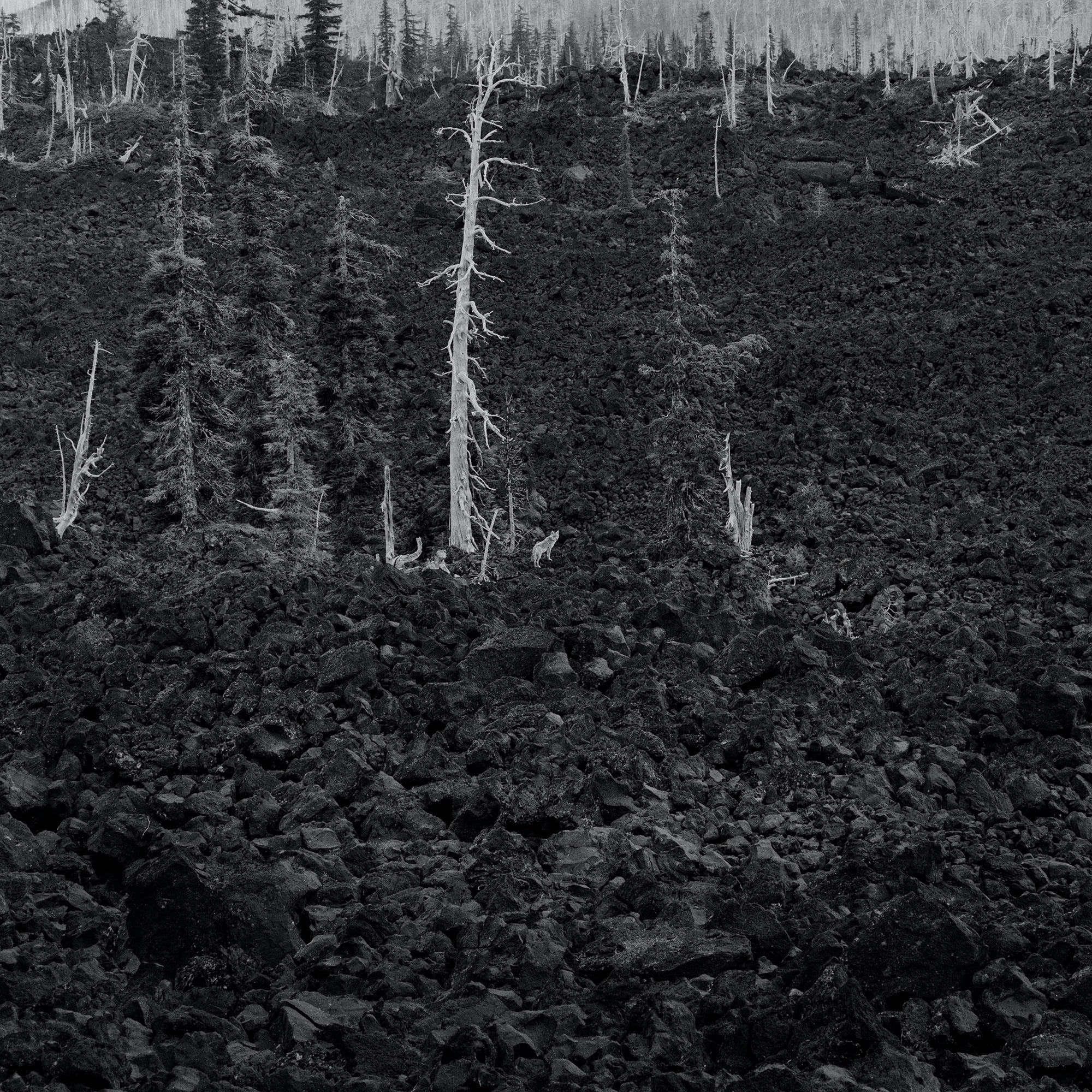
I wake before sunrise and head into the mountains west of Bend Oregon and into a brewing autumn storm. I drive up into a 10 square mile field of lava. The barren black rock folds onto itself extending in sharp relief to the horizon. The road that bisects this place will close for the winter in a few weeks. I park and hike to an overlook perch and setup my Hasselblad, load a roll of black and white film, and look south toward the Sisters Mountains, waiting for sunrise. The mountains are hidden behind a veil of storm clouds streaming from the west. I put my eye to the viewfinder and there, within its bordered confines, my imagination opens. It’s always this way. The framed view becomes my canvas, my whole world. It is the place I am both lost and found. Landscape photography is an art of observation and discovery. The sunrise peaks from below the storm layer, lighting the mountains lower flank. Clouds stream east like flowing water. Rain begins to fall.
Someone walks up to my perch awhile later and tells me the view is normally excellent, but these clouds are in the way, that it’s too bad it’s raining. They ask how long I’ve been here. I tell them a few hours and they look puzzled. They don’t stay long and I watch them drive down the curved road and disappear. This is art as verb. The process. Not the why, but the examination of self, the world, and where the two meet. It’s also magical. I don’t mind about the clouds.
While methodologies differ, the base process in all this is the same whether you’re out here under a building rainstorm or in a warm studio or on a stage or sitting in front of a blank page. The detachment from the requirements placed upon you to explore your own imagination, allowing it space for possibility. What it says about you, about your world, about what you want to reveal.
The rain has tapered off and my fingers are numb from cold. Little red-breasted birds dart around the lava, picking at something I don’t see and a lone coyote comes silently trotting down the trail and stops below me. It doesn’t move a muscle and stares off for a full minute before darting into the lava field as effortless as a blowing leaf. She reappears a hundred yards away on a rise of black rock next to a tall dead tree, bleached white from sun. She stands in still repose looking back, her light fur in contrast with the black volcanic rock. Another watcher. I shift my camera away from the mountain and capture a single frame of her. I bend to load more film and when I look back, she’s gone.
From the Archive
I recently completed a project I’ve been wanting to do for some time. The organization of my entire negative film archive. After I develop film from a trip I cut and sleeve each roll into a plastic archival sheet. I’ll look and choose which frames I want to scan and work on. Those hero negatives are then individually cut, sleeved, and put into a finals case. The rest of the negative sheet is put into another case and stored away. It’s those stored cases I wanted to organize.
I went through all of them, organizing each binder by date, trip, and project. Thousands and thousands of negatives, representing 23 years of work. My overall goal was not to simply have an organizing project, which is enjoyable enough, but to have them organized in a way I could slowly go back through, over the coming years, and look with fresh eyes. To see what I missed with my first edits. I’ll post some of them here, in a section I’m calling, “From the Archive”.
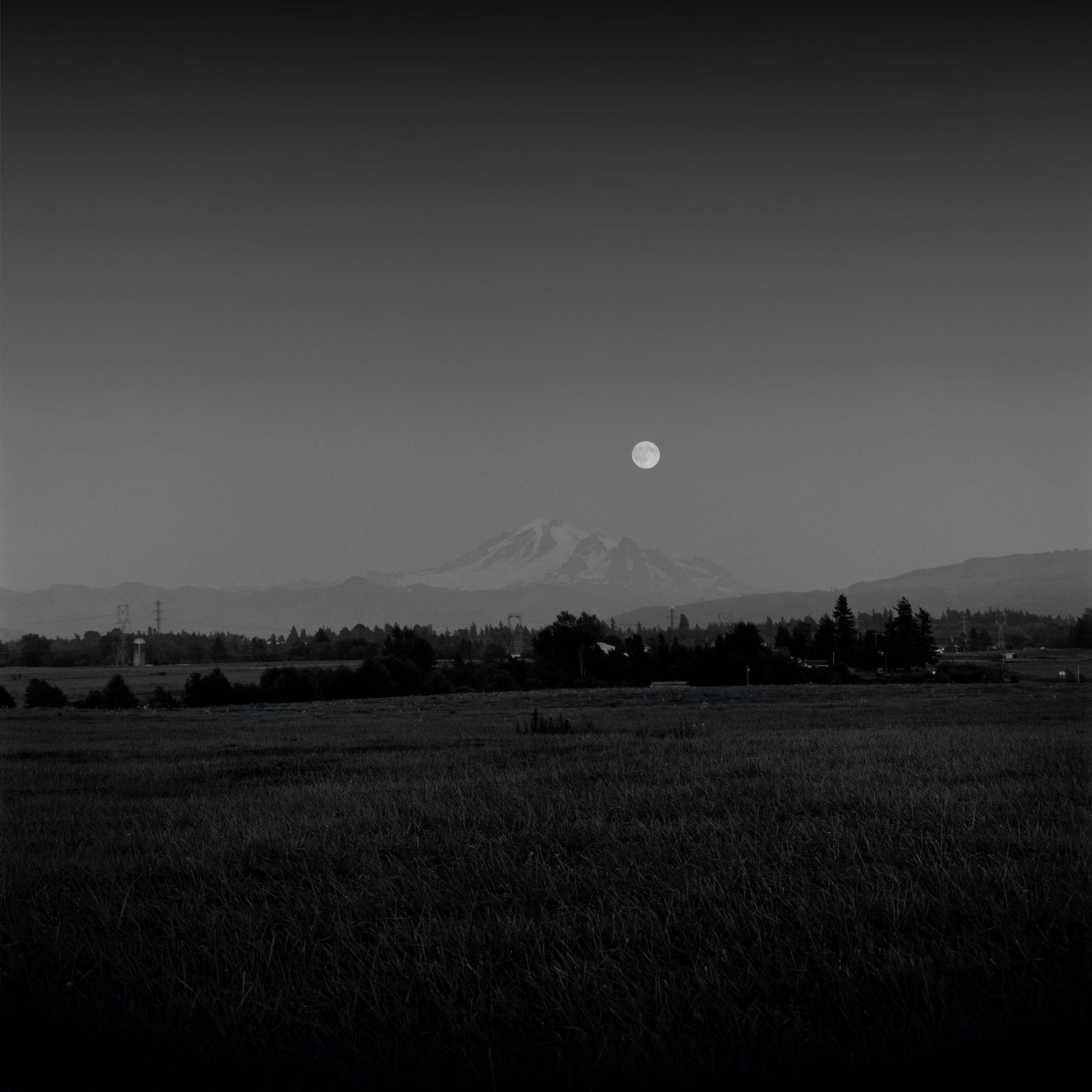
Here is an image I photographed in 2009 in northern Washington State, between Bellingham and the Canadian border. My mom and I had been crisscrossing the open farmland for sunset. We weren’t getting much and were heading back to Bellingham when she saw the full moon rising from behind the flanks of Mount Baker. Excitement shot through and we raced the backroads looking for a foreground. I setup the image and remembered that to get detail (so the moon won’t blowout and just be a bright circle) in a full moon, you can use the sunny 16 rule (1/ISO F/16). I set the exposure and hoped I’d get some detail in the shadowed foreground.
All my images and words are mine, produced by my human mind and human hands. I have never, nor will ever, use any form of AI to make, edit, or construct any of my work. These are all products of my own limited human creativity and intellect.
Black & white images are photographed on Ilford Delta 100 film, developed in Kodak X-tol developer diluted to 1:1.
Mt. Shakspere is indeed spelled this way. The USGS formally adopted the name in 1981.
Just... wow. Stunning. Both the words and images.
I feel honored and privileged to be invited to share glimpses of your world and work.